



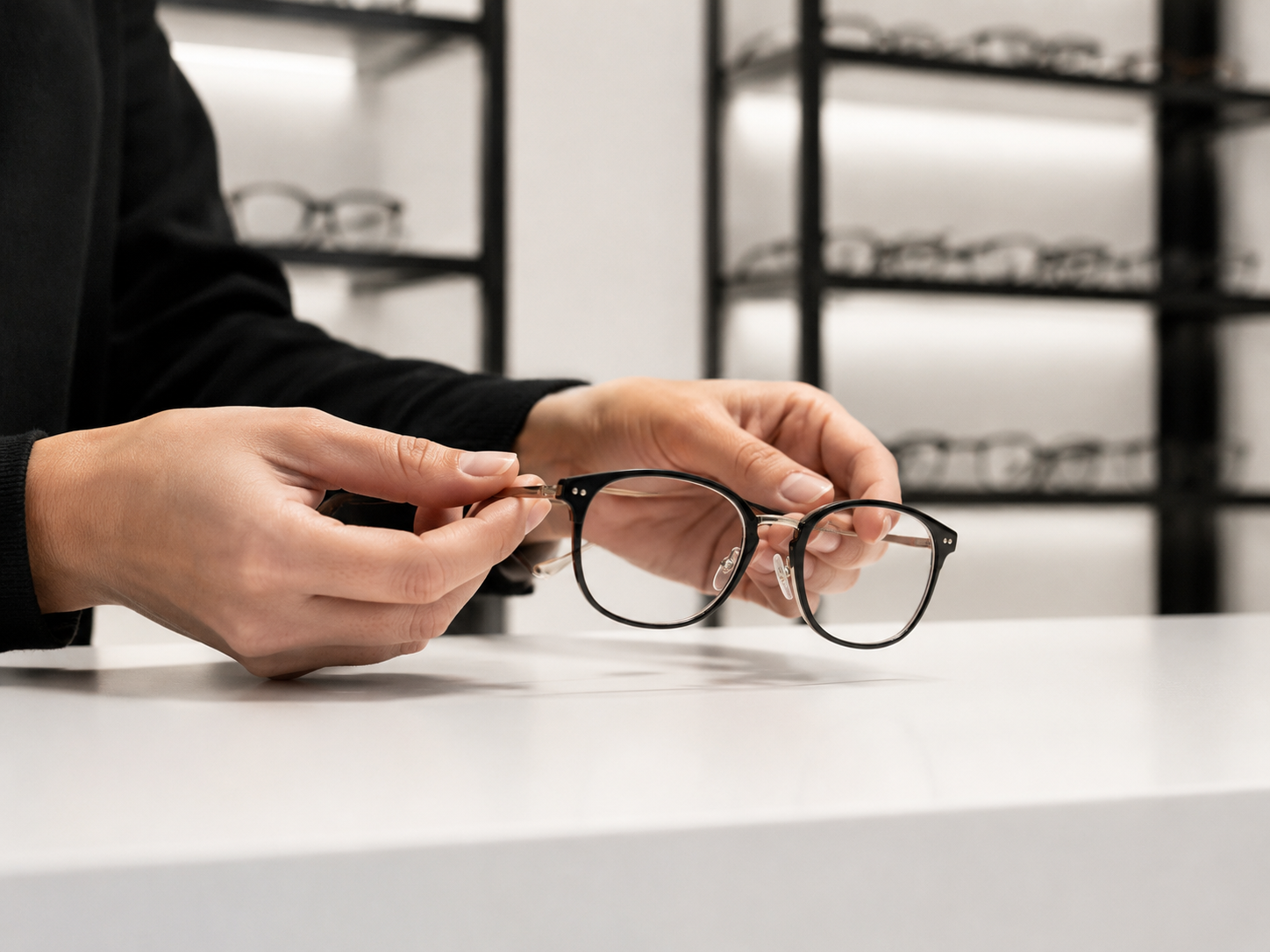
Eyeglasses: How to Choose Frames & Lenses That Suit You
Prescription glasses are one of the most common items we wear every day. They're not just a frame with lenses. They're something that affects your vision, comfort, appearance, and how you move through your day.
For many people, prescription glasses are worn from morning to night: at work, while driving, on the computer, during outings, on vacation, and in every small daily moment. That's why their selection should not be rushed or based solely on the first design you liked in a picture.
A good pair of prescription glasses must combine three basic elements: correct fit, suitable lenses, and a frame that suits your face and style. If one of these doesn't work correctly, the result can be uncomfortable, tiring, or simply not express your personality.
It's not just a matter of myopia, hyperopia, or astigmatism. It's a matter of daily experience. How does the frame sit on your nose? Does it press behind your ears? Does it fit the width of your face? Can it support the lenses you need? Does it aesthetically appeal to you?
In this guide, we'll look at what to consider before choosing prescription glasses, how to navigate between frames and lenses, when photochromic lenses are worth it, and how you can complete your glasses at Red Raven.
Why prescription glasses are not just a frame
Many people start choosing prescription glasses by looking only at the design. This is logical, because the frame is the first thing you see. However, a pair of prescription glasses must first function correctly and then look good.
The frame must be able to support the lenses you need. For example, if you have high prescriptions, a very large or very thin frame may not be the most practical option. Similarly, if you need progressive lenses, it's important that the frame has the correct height and fit so that the different vision zones work comfortably.
Fit is also crucial. A frame that is too narrow can press on the temples. One that is too wide can constantly slip. If the bridge doesn't sit correctly on the nose, the glasses can slide down or leave marks. All these are small details that become very important when you wear glasses for many hours a day.
Furthermore, prescription glasses are part of your image. They can make your face look sharper, softer, more modern, or more classic. A good frame shouldn't just "fit." It should flatter you and match the way you dress and move daily.
So, the right choice is not "which design is nice?" It is: which design looks good on me, fits correctly, and can support the lenses I need?
Prescription eyeglass frames: what to look for
The frame is the base of your glasses. It determines the fit, aesthetics, and to a large extent, daily comfort.
The first point to consider is the width of the frame. The frame should naturally follow the width of your face. If it's too narrow, it will press. If it's too wide, it will look "foreign" on your face and will likely slip.
The second element is the bridge, which is where it sits on your nose. A correct bridge helps the glasses stay in place without falling or pressing. For some, frames with nose pads work better because they can be adjusted more easily. For others, acetate or plastic frames with a fixed bridge work better.
The third point is the lens shape. More rectangular frames give a clearer, more dynamic line. More round or oval frames give a softer result. Oversized frames can work very well aesthetically, but it needs to be considered if they match your prescription and the type of lens you need.
Weight is also important. If you wear glasses for many hours, a very heavy frame can become tiring. A lightweight frame, whether metal or acetate with proper weight distribution, can be more comfortable for daily use.
Finally, don't choose a frame just because it's trendy. Prescription glasses are something you will wear often. You want a design that you like now, but that you can wear for months without getting tired of it.
If you want to see different lines and shapes, you can start from the men's eyewear collection or the women's eyewear collection, depending on the style you are looking for.
How to choose a frame based on your face
There isn't one frame that suits everyone. However, there are some basic guidelines that can help you start correctly.
If you have a more round face, more angular or rectangular frames usually work well. They add structure and make the face look more balanced. A very round frame can emphasize the roundness even more.
If you have a more square face, rounder or oval lines might flatter you because they soften the angles. This doesn't mean you should completely avoid square frames, but it's good to be careful not to make the result excessively severe.
If you have an oval face, you have more flexibility. Most shapes can work well, as long as the frame is the correct size and not disproportionate to your features.
If you have a more long face, frames with a slightly greater height or a more intense line can help balance the length of the face. Very narrow lenses can make the face look even longer.
Beyond face shape, personal style also plays an important role. If you dress more minimally, you might prefer clean lines, black, metal, or neutral frames. If you like more striking looks, you can opt for oversized, statement, or more unique shades.
The most important thing is to try them on. The same frame can look completely different from face to face. That's why trying them on in a store can help you much more than a simple product photo.
Prescription lenses: what options are available
Lenses are the most technical but also the most important part of prescription glasses. The frame provides the style and fit, but the lenses are what determine visual comfort.
The most basic are simple prescription lenses, which correct myopia, hyperopia, or astigmatism, depending on your prescription. They are the classic choice for daily use, whether you wear glasses all day or only at specific times.
There are also prescription and sunglass lenses combined, meaning lenses with prescription and sunglass tint. They are ideal if you want to use your favorite frame as sunglasses, but with the correction your vision needs. This is a very practical option for driving, summer, holidays, or daily outdoor use.
Photochromic lenses are a more flexible solution. They adapt to light, darkening when exposed to UV radiation and becoming lighter indoors. They don't always completely replace a separate pair of sunglasses, but they can be very practical for those who frequently change environments throughout the day.
There are also lenses with special coatings, such as anti-reflective coating, filters for screens, or coatings that aid in cleaning and durability. The choice depends on your needs, your usage, and your prescription.
The important thing is not to choose lenses "randomly." The right lenses should be based on your prescription, your lifestyle, and how you use your glasses throughout the day.
Prescription and sunglasses in one
One of the most practical options is to convert a Red Raven frame into prescription and sunglasses together. This means you can have prescription lenses with a sunglass tint, so you can see clearly and be protected from the light.
This solution is ideal for those who spend a lot of time outdoors, drive frequently, or want a pair that works comfortably in the summer. If you already wear prescription glasses, you know how uncomfortable it can be to constantly switch between prescription glasses and sunglasses. A pair with prescription sunglass lenses solves a large part of this problem.
The choice of lens color is also important. Brown lenses give a warmer and more natural feel, gray lenses maintain a more neutral color perception, while more unique shades can give a more fashionable result. Depending on the frame, you can create a pair that is both practical and aesthetically very strong.
Not all frames match all lenses. That's why proper guidance is important so that the final result is functional, comfortable, and beautiful.
If you are more interested in sun use, you can also see the complete guide to polarized glasses, to better understand how lenses affect visual comfort in bright light.
Photochromic lenses: when are they worth it?
Photochromic lenses are a very practical solution for those who want a more flexible pair of glasses. Their basic function is that they change shade depending on light exposure.
Indoors, they remain lighter, while outdoors, they darken. This makes them ideal for people who frequently move between different environments throughout the day, such as from the office to the street, from home to the car, or from indoor to outdoor environments.
The great advantage is convenience. You don't have to keep changing glasses. You have one pair that can cover more situations. For daily use, this can be very convenient.
However, they are not necessarily the perfect solution for everyone. If you want clear sunglasses for intense sunlight, the beach, or very bright conditions, you might prefer a separate pair with a more specific sunglass lens. But if you want convenience and adaptability, photochromic lenses are worth adding to your list.
The choice depends on how you live your daily life. If your glasses need to follow you in many different lighting conditions, photochromic lenses can make the experience more comfortable.
Comfort and daily use
Prescription glasses must be comfortable. This sounds simple, but in practice, it is one of the most important criteria for selection.
A frame might look great for a few minutes in front of the mirror, but if after an hour it presses, slips, or burdens your nose, it's not the right choice for daily use.
Comfort depends on many things: the weight of the frame, the width, the bridge, the temples, the size of the lenses, and how the weight is distributed on the face. Especially if you wear glasses for many hours, these details make a big difference.
It's also important how the frame sits when you move. If it constantly slides down, you'll be touching it constantly. If it presses behind your ears, it will become tiring. If the nose doesn't support the frame correctly, you'll feel that it's not sitting steadily.
You shouldn't have to worry about the correct fit. Ideally, you put on your glasses and after a while, you forget about them. This is a sign that the frame and lenses are working correctly together.
Prescription glasses at Red Raven
At Red Raven, you can now get your prescription glasses made at our stores in Chalandri and Peristeri.
You can come with your prescription, choose the Red Raven frame that suits you, and complete your glasses with the appropriate lenses, depending on your needs.
The process is not just "choose a frame and put lenses in." It's a more comprehensive selection experience. You see the designs up close, try on different shapes, compare fits, and choose lenses that match your daily use.
You can create glasses with simple prescription lenses, prescription and sunglass lenses combined, photochromic lenses, or colored lenses. This way, the frame you like can be adapted to your vision needs and the way you want to wear it.
If you want to try different designs in person, you can visit our stores:
Chalandri: Katsoulieri 4, 15233
Peristeri: Ethnikis Antistaseos 43 & Delfon, 12134
For more ideas, you can also see the Red Raven men's eyewear collection or the women's eyewear collection.
FAQs
Can I put prescription lenses in a Red Raven frame?
Yes, in many Red Raven designs you can add prescription lenses, depending on the frame, your prescription, and the type of lens you need. The final selection should be made with proper guidance at the store.
Can I get prescription and sunglasses made together?
Yes. You can choose lenses with prescription and sunglass tint, so your Red Raven frame also functions as prescription sunglasses. It's a practical solution for driving, outdoor use, and summer.
What are photochromic lenses?
Photochromic lenses are lenses that adapt to light. They become darker outdoors and lighter indoors, offering greater flexibility for daily use.
How do I choose the right prescription frame?
The right frame should fit your face, sit comfortably on your nose and behind your ears, not slip, and be able to support the lenses you need. Trying them on in person helps a lot.
Is a metal or plastic frame better for prescription glasses?
There isn't one right answer for everyone. Metal frames often have a lighter and more refined feel, while plastic or acetate frames give a more distinctive style and stable presence. The choice depends on your face, style, and lenses.
Can I bring my prescription to Red Raven?
Yes. You can bring your prescription to Red Raven stores in Chalandri or Peristeri and choose the frame and lenses that suit your needs.
Where can I get Red Raven prescription glasses made?
The prescription glasses service is available at Red Raven stores in Chalandri and Peristeri.



1 comment
Καλησπέρα! Δέχεστε συνταγές ΕΟΠΥΥ για γυαλιά οράσεως;
Ευχαριστώ
Μαρια Γκουσδοβα
Leave a comment
This site is protected by hCaptcha and the hCaptcha Privacy Policy and Terms of Service apply.